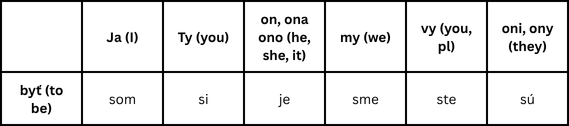
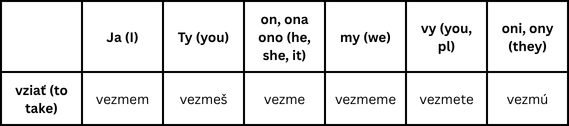
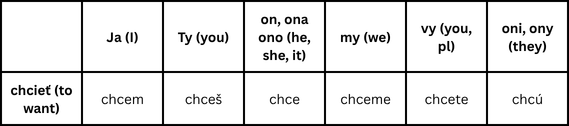
When you start learning Slovak, present tense might seem intimidating but here is the good news: verbs belong to predictable pattern families. Today we will be dealing with irregular verbs. You can find the suffixes -ať/ať and -íť/iť here or -ie/e and -je here.
Use
It is used for actions happening right now, habits, routines, truths or even scheduled future events.
Práve som doma (happening right now)
Každý deň jedia mäso (routine)
Zajtra ide do kina (scheduled future event)
Conjugation
1, Irregular verbs with complete stem changes
This is the trickiest category as verbs that belong to this category change completely from the infinitive to the present tense.
2, Irregular verbs with with root changes
Some verbs undergo significant spelling or vowel shifts when moved from the infinitive to the presente tense.
3, Irregular verbs with irregular ending patters
Some verbs take very unique endings, thus we can´t put them in any other category.
Additional rules
1, You don´t need pronouns
You dont have to say “ja neviem”, because the verb ending tells you what person it is without needing to mention that. Also, leaving out pronouns sounds much more natural.
ja jem -> jem (to eat)
2, Negation is super easy
Just attach ne- directly to the front of the verb.
viem -> neviem (to know)
3, Prefix derivates stay irregular
In english, adding a prefix to an irregular verb keeps it the irregular (take -> mistake). Slovak works the exact same way. Any prefix added to an irregular verbs preserves its irregular conjugation.
ísť (to go) -> prísť (to arrive)
DIALOGUE
Dnes tu je veľmi veľa ľudí, že Paľo?
To áno, ja asi idem niekde inde.
Aj ja chcem ísť niekde inde, ale nemôžem.
Ja teda idem a napšem ti koľko tam je ľudí.
Dobre. Vezmeš mi aj nejaký dezert Paľo?
Dohodnuté. Maj sa Martin.
GAP FILL
1. Complete the sentences
SPEAKING
1. Answer the questions
a)Prečo Paľo chce ísť niekde inde?
b)Čo Paľo vezme Martinovi?
c)Ako dá vedieť Paľo Martinovi, že majú dezert?
2. Practice the vocabulary
a)Create your own sentence using any verb from the text or the explanation section.